



 53 / 68

53
Extrusion 4/2017
BOGE KOMPRESSOREN Otto Boge
GmbH & Co. KG
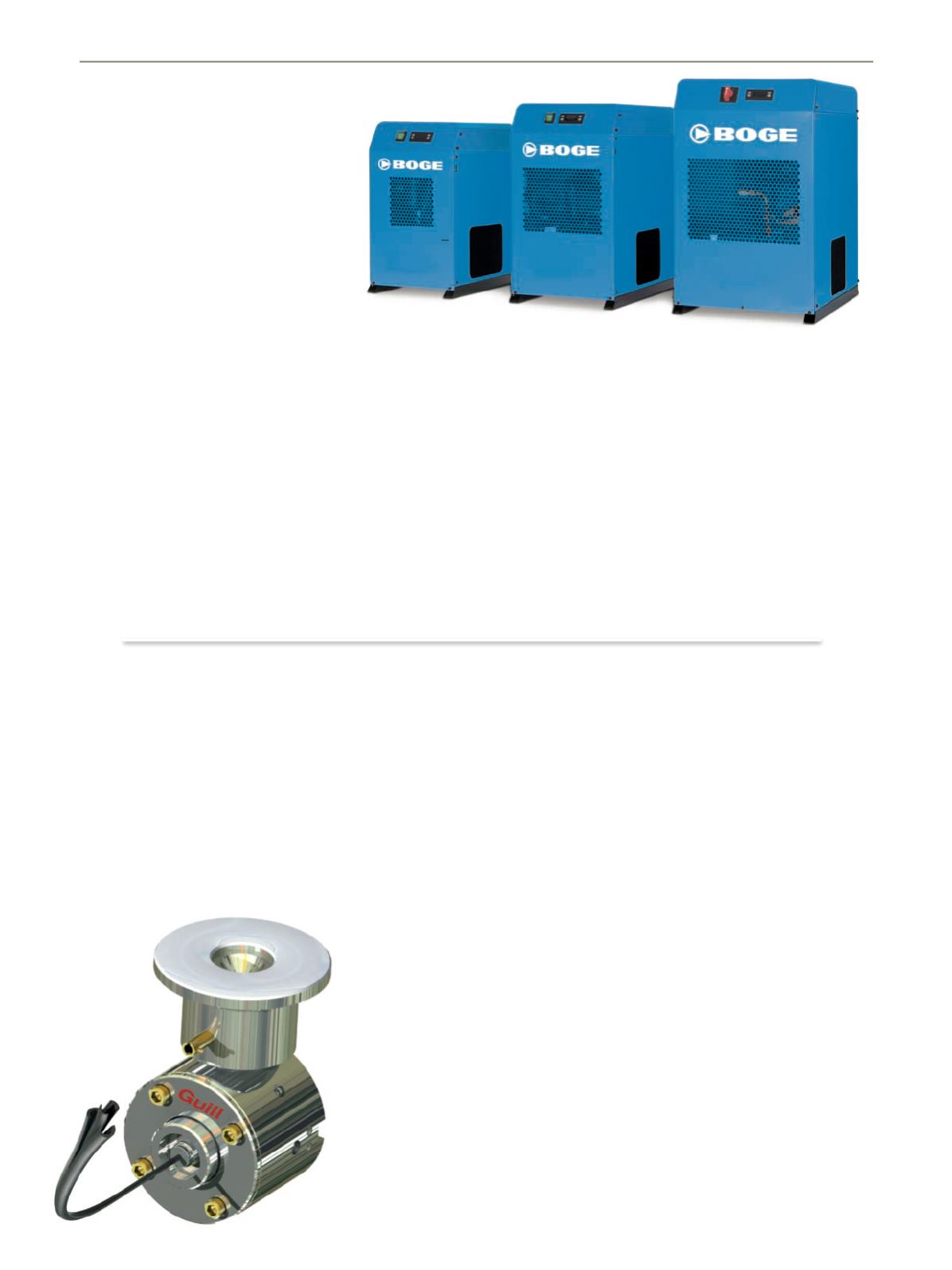
www.boge.deDie neue DS-2-Baureihe von BOGE legt die Messlatte für Kältetrockner höher
(Bild: BOGE KOMPRESSOREN)
den neuen vollintegrierten Aluminium-
Wärmetauscher sind Leistungsverluste
im Kältekreislauf und der Bedarf an Käl-
temittel sehr gering. Kombiniert mit ei-
ner um bis zu 30 Prozent reduzierten
Leistungsaufnahme sind die Gesamtbe-
triebskosten des BOGE DS-2 sehr nied-
rig. Für einen optimalen Betrieb verfügt
die Baureihe serienmäßig über eine digi-
tale Steuerung inklusive eines potenzial-
freien Alarmkontakts. Dieser informiert
sofort, wenn sich Betriebsbedingungen,
wie der Drucktaupunkt, im kritischen Be-
reich bewegen. Modelle ab 2,6 m
3
/min
sind optional mit Energiesparfunktion er-
hältlich. Diese senkt die Leistungsauf-
nahme im Teillastbetrieb noch weiter ab.
Ausgelegt für 50 und 60 Hz eignen sich
die neuen DS-2-Kältetrockner für den
weltweiten Einsatz.
Mit dem FRDA-Tandemtrockner nimmt
BOGE erstmals einen kombinierten Käl-
te- und Adsorptionstrockner ins Produkt-
portfolio auf. Die neue Technologie er-
gänzt das bisherige Angebot an Adsorp-
tionstrocknern. FRDA ist eine optimale
Lösung, wenn konstante, aber auch va-
riable Drucktaupunkte zwischen –70 °C
und +3 °C benötigt werden. Die Kombi-
nation der zwei bewährten Trocknungs-
verfahren ermöglicht eine hohe Energie-
effizienz und Flexibilität. Über die Steue-
rung des Tandemtrockners kann einfach
zwischen den Drucktaupunkten eines
Kältetrockners und denen eines Adsorp-
tionstrockners gewechselt werden, ohne
dass Hardwareanpassungen nötig sind.
Im Ergebnis wird unabhängig von jahres-
zeitlichen Temperaturschwankungen ei-
ne Restfeuchte von bis zu 0,003 g/m
3
er-
zielt. Zudem zeichnet sich FRDA durch
sein kompaktes Maschinendesign aus.
Dadurch ist die Technologie für die Con-
tainerinstallation geeignet und, wenn
wenig Platz vorhanden ist.
GUILL TOOL & ENGINEERING CO., INC.
www.guill.comweld lines, inconsistent wall thickness,
plus material and process variations. Ad-
ditional errors include difficult-to-process
materials and demanding applications
where there is zero fault tolerance.
Seeking to design the next generation
multi-layer die to overcome these chal-
lenges, the engineers at Guill looked for
a way to incorporate this technology into
an updated version of the 800 Series.
This led to the creation of the 800 Series
Hybrid. The inherent benefits of the 800
Series are retained, including compact
design, low residence time and a com-
mon deflector bore that eliminates tole-
rance stack up. The challenge was to
create a hybrid design that incorporates
the benefits of layer overlapping, while
reducing unnecessary complexity and
making the technology more cost-af-
fordable for customers. This was
achieved by overlapping layers in each
semi-deflector, using a single cone. The
highly efficient design of the 800 Series
Hybrid reduces cost and size, as opposed
to other methods of overlapping layers.
Guill announces the introduction of a
new version of its popular 800 series,
known as 800 Series Hybrid. In some ex-
trusion applications that utilize cross-
heads and inlines, layers of the exact
same material are applied multiple times,
using a single die. This method is used to
reduce the propensity for errors caused
by gels breaking through a thin wall,
New Series Hybrid Extrusion Tooling
Essential benefits of the 800 Series Hy-
brid include eliminating weld lines in ma-
terials through patented overlapping
technology, producing a more consistent
finished product; reduced sensitivity to
changes in viscosity; reduced sensitivity
to changes in line speed; myriad material
and multi-layer application possibilities;
works in all tubing and jacketing applica-
tions with a wide range of materials; low
residence time; compact design and a
low tolerance stack-up error factor, all re-
sulting in improved concentricity.
The 800 Series Hybrid extrusion tool
greatly reduces stagnation, because
overlapping layers are more inherently
balanced than single layers and also be-
cause each semi-deflector is “tuned to
flush.” Conventional deflectors must si-
multaneously achieve a balance between
flushing, balancing and eliminating the
weld line. There is less difference bet-
ween the slowest moving material and
the fastest moving material in the deflec-
tor channels, thus making the viscosity
more consistent in the deflector.