


 29 / 68

29
Extrusion 4/2017
Diversity of BKG
®
underwater pelletizers
In a typical underwater pelletizing application, molten polymer
from the extruder passes through a melt pump, which provides
a controlled, uniform melt pressure; then through a melt filter
or screen changer, which removes contaminants; then through
a hydraulically actuated polymer diverter valve; and finally into
the die plate in the pelletizer itself. (The diverter valve is neces-
sary to divert material at start-up until it has reached optimal
flow properties; it also makes it possible to separately shut
down the extruder and the pelletizer.) A water bypass ensures a
quick and reproducible redirection of the process water during
start-up from recirculation to the cutting chamber. This ensures
a fail-safe, one button start of the underwater pelletizing sys-
tem with any polymer.
The second step involves two components: a centrifugal dryer
for removal of residual water; and a tempered water system
that conditions process water by bringing it to a controlled
temperature and removing fine particles that are generated
during pelletizing.
While the operator of a standard BKG
®
underwater pelletizing
line uses a hand wheel to advance the pelletizer with its cutting
knives into position at the die plate in the cutting chamber,
Nordson has developed a hydraulically actuated alternative sys-
tem that automates cutter advance. The BKG
®
Type AH auto-
matic pelletizer accommodates throughputs from 5 to 5,000
kg/hr., as against 5 to 2,500 kg/hr for the manual pelletizer. A
larger capacity automatic version, BKG
®
Type AH D, is available
for polymerization lines of up to 35,000 kg/hr and comes in ad-
dition with a hydraulic locking system of pelletizer to cutting
chamber, for operator safety and hands-free start-up.
The hydraulic system ensures a constant pressure of the blade
to the die plate, which reduces wear to die plate and blades,
eliminates “tails” or mal-formed pellets, and minimizes opera-
tor intervention. As hydraulic oil is a non-compressible medium,
this system avoids a “hopping” of the blades on the die plate
surface.
Another benefit of this hydraulic blade adjustment system is
automatic blade sharpening, which can be programmed to oc-
cur periodically. Hydraulic pressure increases from the level that
is typical in standard production until a rise in motor torque in-
dicates a metal-to-metal contact between blades and die face.
(Normally a thin polymer layer separates the two.) At this point
hydraulic pressure drops sharply to a level that is sufficient to
carry out sharpening while still being higher than standard pro-
duction pressure.
Custom-designed alternative die plates are also available from
Nordson. While the standard plate has holes that are 3 mm in
size, for example, a die plate for micro-pellets may have holes
measuring only 0.4 mm. Also available are oil- and steam-hea-
ted alternatives to the standard electric cartridge heaters; with
heating cavities intimately interconnected with the die plate
holes, these systems provide even more efficient heating and
prevent freeze-off of material in the holes, which can be a par-
ticular problem in producing micro-pellets. Another alternative
design is that of pressure-reduced die plates, which aid in the
processing of high-viscosity polymers.
Alternatives are also available in cutter hub design. In standard
underwater pelletizing, the cutter hub and blade assembly pro-
duces pellets from polymer as it exits the holes in the die by ro-
tating rapidly against the die face, with blades mounted at an-
gles to the face of either 50 degrees (“angled”) or 90 degrees
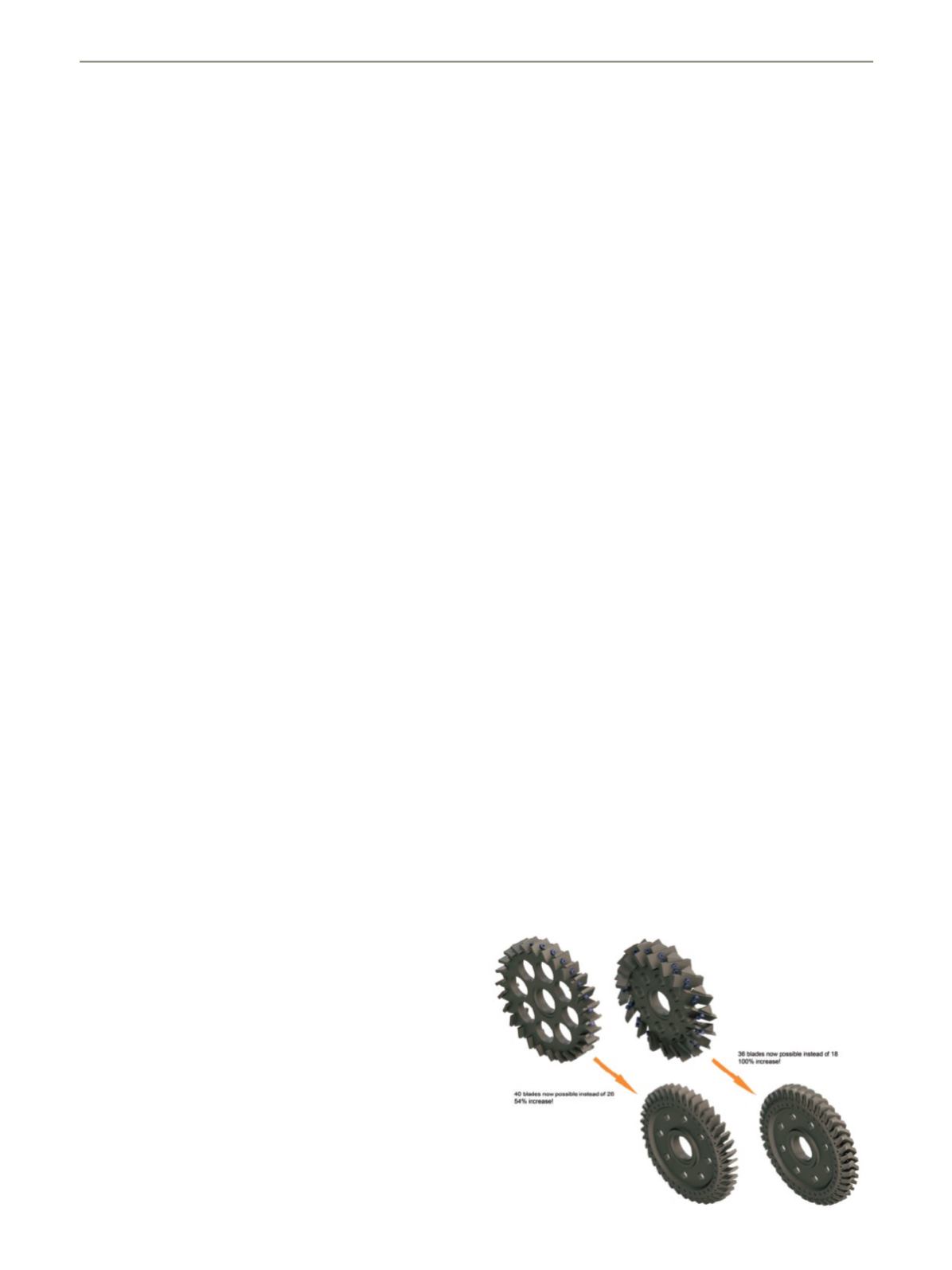
(“straight”). Recently Nordson has developed improved designs
that increase throughput by accommodating up to 100 percent
more angled blades per hub (36 instead of 18) or 54 percent
more straight blades (40 instead of 26). As an alternative to in-
creased throughput, the operator can reduce pelletizer RPM,
maintaining standard throughput while reducing wear to die
plate and blades.
Another pelletizing innovation developed by Nordson is auto-
mated inline grinding of the die face. While sending out a die
plate for grinding can be very costly in terms of lost production,
the new system takes only a few minutes. The operator simply
stops the line, disassembles the cutter hub, and installs a spe-
cial die plate surface grinding tool. Besides practically eliminat-
ing downtime, the system helps lengthen the working life of
the die plate.
BKG
®
tempered water systems: three tiers
Nordson has developed options for tempered water systems
that vary in cost, sophistication, and automation.
• BKG
®
Master-Line
: an entry-level system. The guiding idea
for this system is “to contain all the essentials: everything you
need and nothing you don’t.” Modular in design and com-
pletely skid-mounted, the system has dual-door (front and
back) access to the dryer for easy cleaning. Models are available
with capacities of up to 2,000 kg/hr.
A recent innovation enables users of the BKG
®
Master-Line™
system to upgrade their new equipment purchase or their exist-
ing equipment. This is an optional belt filter that reduces
downtime and operator intervention by providing continuous,
automated filtration of fines. The new water filtration system
also has a finer filter mesh – 150 µm versus the 200 µm capabi-
lity of the standard system available with BKG
®
Master-Line™
pelletizers. The continuously rotating filter belt is constantly
cleaned by spray nozzles at one end and a scraper at the other,
allowing fines to be collected in a catch basin beneath the belt.
In the standard system, by contrast, fines are collected on a
Old vs New Cutter Hub Design